
SilverSpeak: Overcoming AI Detectors with Visual Deception
SilverSpeak: Evading AI-Generated Text Detectors using Homoglyphs
This paper introduces SilverSpeak, an adversarial attack method that utilizes homoglyphs (visually identical but differently encoded characters) to evade AI-generated text detectors. By evaluating seven diverse detectors including Binoculars, Fast-DetectGPT, and watermarking techniques across five datasets, the authors demonstrate that even low-level homoglyph replacement can lead to a total breakdown of detection reliability.
TL;DR
Detection of AI-generated text is a cat-and-mouse game where the "cat" just got blinded. A new research paper titled SilverSpeak reveals that by simply replacing a few Latin characters with visually identical ones from different alphabets—known as homoglyphs—every major AI detector (from OpenAI’s classifier to sophisticated watermarks) can be completely bypassed. This attack reduces detection accuracy to the level of a coin flip.
The Fragile Illusion of AI Detection
As researchers race to build tools that can identify AI-authored content, they have largely relied on three pillars: Perplexity (how "surprised" a model is by the text), Classification (supervised learning on AI vs. human datasets), and Watermarking (mathematical patterns hidden in token selection).
The SilverSpeak authors point out a glaring blind spot: these detectors operate on encodings, not visuals. To a human, "Apple" and "Аpple" (using a Cyrillic 'А') look identical. To a machine, they are fundamentally different sequences of bytes.
Methodology: The Art of the Swap
The researchers tested seven state-of-the-art detectors, including the high-performing Binoculars and Fast-DetectGPT. They applied a simple transformation:
- Random Attack: Replace 5%, 10%, 15%, or 20% of characters with homoglyphs.
- Greedy Attack: Replace every possible character that has a visual twin.
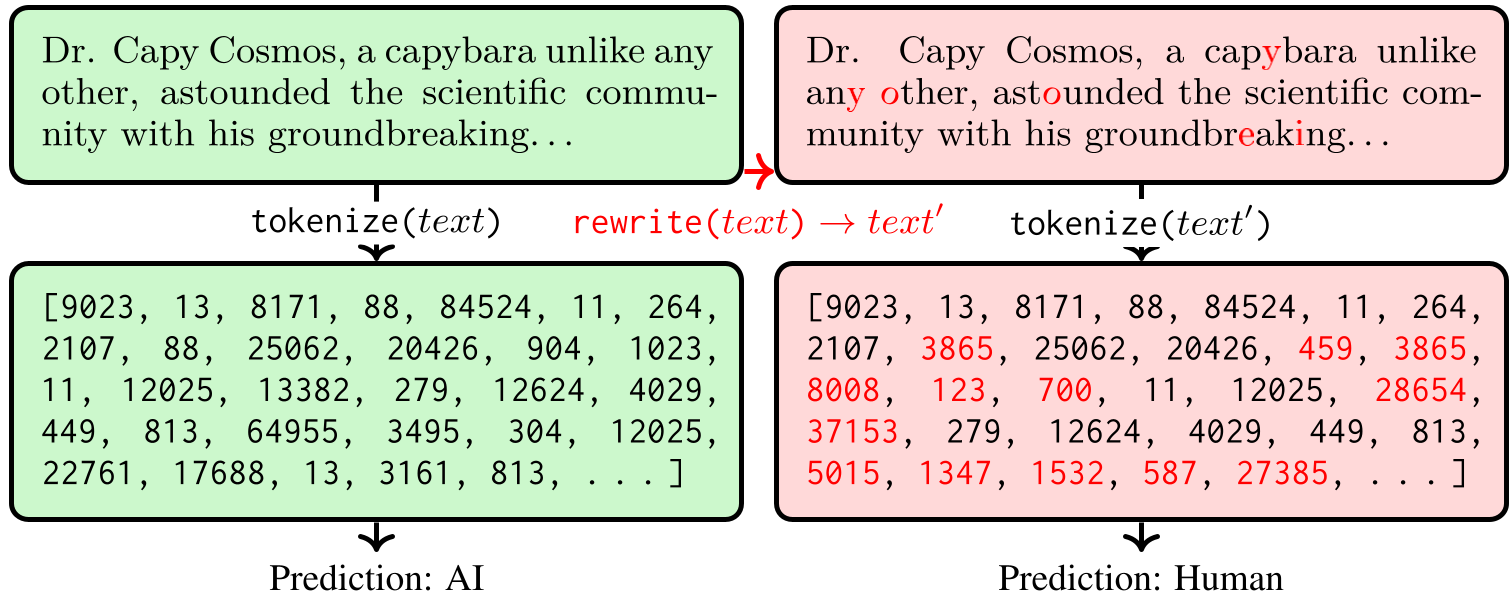 Figure 1: Notice how the tokenization (bottom boxes) changes wildly despite the text looking nearly identical to a human reader.
Why Does It Work? The Technical Justification
The paper provides a deep dive into why different architectures fail:
1. Perplexity-based Detectors (Binoculars, DetectGPT)
These models calculate how likely a token is to appear. Because homoglyphs are rare in standard training corpora, the Byte-Pair Encoding (BPE) tokenizer splits words into tiny, nonsensical fragments. This causes the "Perplexity" to skyrocket, making the AI text look like "noisy" or "unpredictable" human writing.
2. Classification Models (ArguGPT, OpenAI)
Detectors like ArguGPT use RoBERTa to create text embeddings. The authors found that homoglyphs shift these embeddings into an "unseen region" of the vector space.
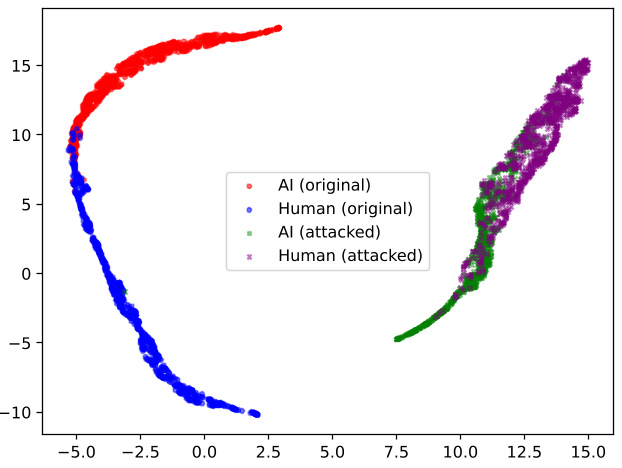 Figure 2: UMAP visualization showing that while original AI and human texts are separated, attacked texts (green/purple) cluster in a completely different, mixed space.
3. Watermarking
Watermarks depend on a fixed "green list" of tokens determined by the previous token. Since homoglyphs alter the tokenization, the "seed" for the green list changes, breaking the mathematical chain that the detector looks for.
Results: A Total Collapse
The results were devastating for the "detection" camp. Across all datasets (academic abstracts, news, and essays), the Matthews Correlation Coefficient (MCC)—where 1.0 is perfect and 0 is random—tanked from an average of 0.64 to -0.01.
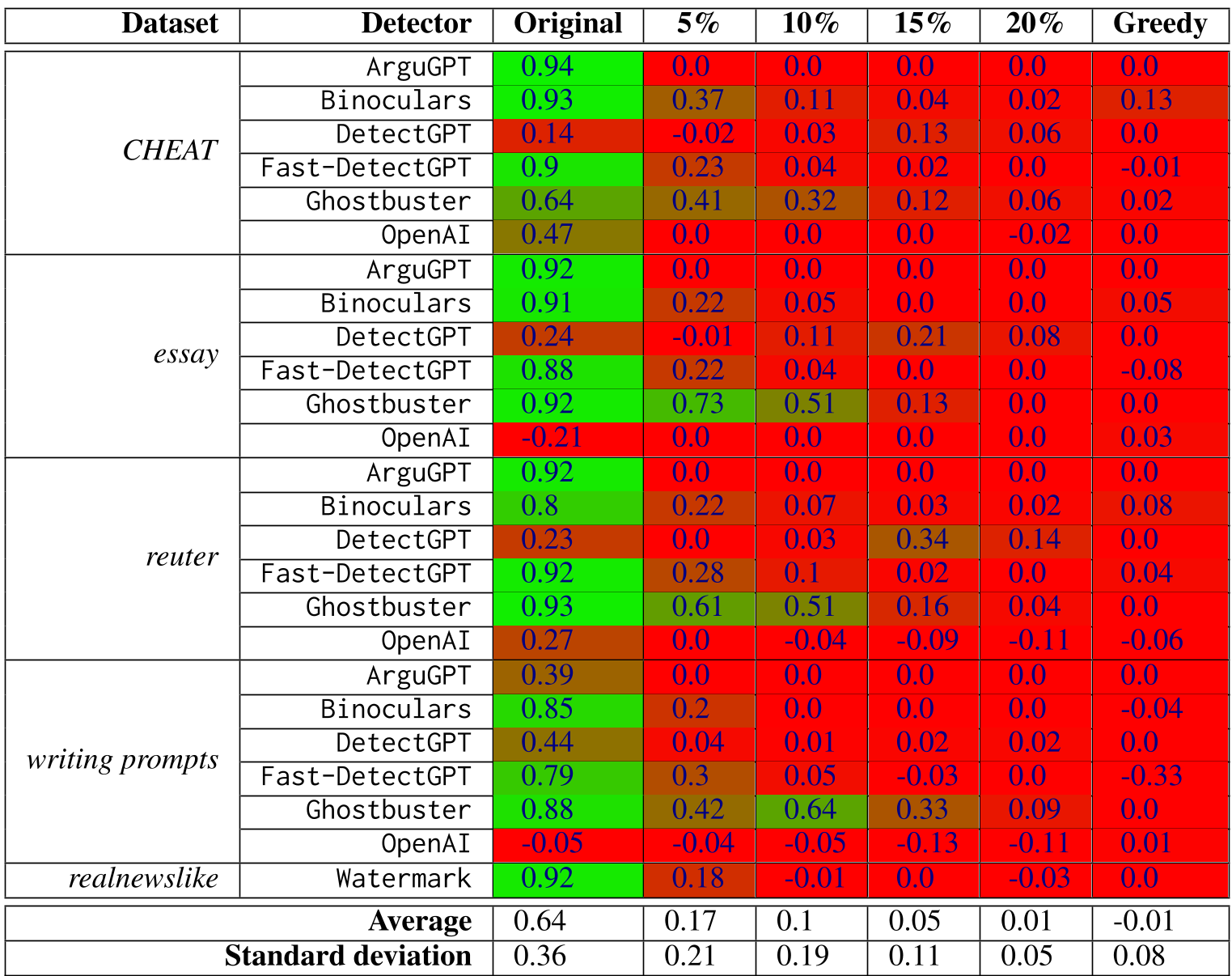 Table 1: The MCC across various datasets and percentages. By the 20% or 'Greedy' stage, detection power is effectively non-existent.
Deep Insight & Conclusion
The core takeaway from SilverSpeak is that AI text detection is currently a house of cards. The reliance on brittle statistical features of sub-word tokens makes these systems trivial to defeat with simple scripts that require zero AI knowledge to run.
Potential Remedies:
- Input Character Constraints: Limiting character sets to standard ASCII/Unicode ranges.
- Visual Processing: Using OCR-like architectures that "see" the text as a human does, ignoring encoding tricks.
- Loglikelihood Analysis: Analyzing the distribution of scores rather than raw token sequences.
As it stands, tools marketed to universities and publishers as "LLM Detectors" are vulnerable to a script that any high schooler could write, necessitating a fundamental rethink of how we verify digital authorship.