
[Survey 2025] Scaling Beyond Context: How Multimodal RAG is Redefining Document Intelligence
Scaling Beyond Context: A Survey of Multimodal Retrieval-Augmented Generation for Document Understanding
This paper provides the first systematic survey of Multimodal Retrieval-Augmented Generation (RAG) specifically tailored for document understanding. It categorizes the field through a comprehensive taxonomy—domain, retrieval modality, and granularity—while highlighting state-of-the-art architectures like ColPali and agentic frameworks.
Executive Summary
TL;DR: This comprehensive survey serves as the definitive roadmap for Multimodal Retrieval-Augmented Generation (M-RAG) applied to document understanding. It bridges the gap between text-only RAG and context-limited MLLMs by analyzing how models can now "see" and "retrieve" across pages, tables, and charts simultaneously.
Background Positioning: This work moves beyond "simple RAG" into the SOTA industrial frontier. It maps the transition from OCR-heavy pipelines to vision-native retrieval (like ColPali), positioning M-RAG as the key to processing the "millions of visual tokens" found in enterprise-scale PDF repositories.
1. The Critical Bottleneck: Why Context Length Isn't Enough
Modern Multimodal Large Language Models (MLLMs) like GPT-4o or Qwen2-VL are powerful, but they are hit by a "Context Wall."
- The Scale Gap: Real-world document benchmarks require 20M to 200M visual tokens.
- The Limit: Most MLLMs cap out at 128K to 1M tokens.
- The Result: Feeding 1,000 pages of financial reports into a model isn't just expensive; it's technically impossible. RAG is the only viable path to scale.
2. Methodology: The Three Pillars of Multimodal RAG
The authors propose a taxonomy that defines how a system "thinks" about a document:
A. Retrieval Modality: Do we look or do we read?
- Image-based (OCR-free): Treating pages as "screenshots." Models like ColPali use vision encoders to extract embeddings directly, preserving the spatial relationship of a table or chart that OCR would mangle.
- Hybrid (Image+Text): Combining the literal text (via OCR) with visual features. This is the "safe" route for documents containing fine-print text where visual encoders might hallucinate.
B. Retrieval Granularity: From Pages to Elements
Earlier systems retrieved the whole page. The new vanguard—MARA and RegionRAG—decomposes pages into specific Elements:
- Tables
- Figures
- Text Blocks
- Layout Cues
C. The Hybrid Frontier: Graphs and Agents
The survey highlights a massive shift toward Graph-based RAG. By representing a document as a set of nodes (entities/images) and edges (logic/proximity), models can perform Multi-hop Reasoning (e.g., "Compare the trend in Figure 1 with the text in Section 3.2").
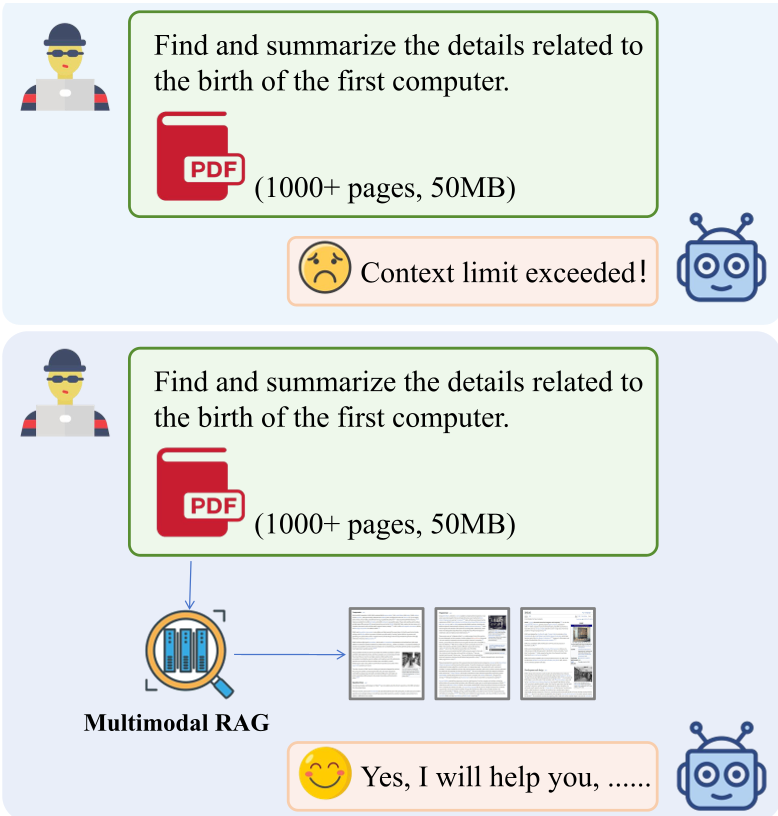 Figure: The interplay between Retrieval and Generation in Multimodal Document Understanding.
3. High-Performance Retrieval: ColPali & Late Interaction
One of the most discussed methods in the survey is the ColPali-style late interaction. Unlike "Bi-Encoders" that compress a whole image into one vector, late interaction allows every "patch" of an image to interact with every "word" in a query.
| Method | Venue | OCR Required? | Modality | Granularity |
|---|---|---|---|---|
| ColPali | ICLR 2024 | No | Image | Page |
| HM-RAG | ACM MM 2025 | Yes | Image+Text | Page/Graph |
| VRAG-RL | Preprint | No | Image | Element |
4. Benchmarking the "Needle in a Haystack"
The survey consolidates performance across core datasets like DocVQA and MMLongBench-Doc.
- Key Insight: While models are getting better at finding the right page, Generation Accuracy (G-Acc) remains the bottleneck.
- The "OCR Paradox": OCR-free models are fast and preserve layout, but OCR-based models still win on documents with "dense, high-precision" text (like legal contracts).
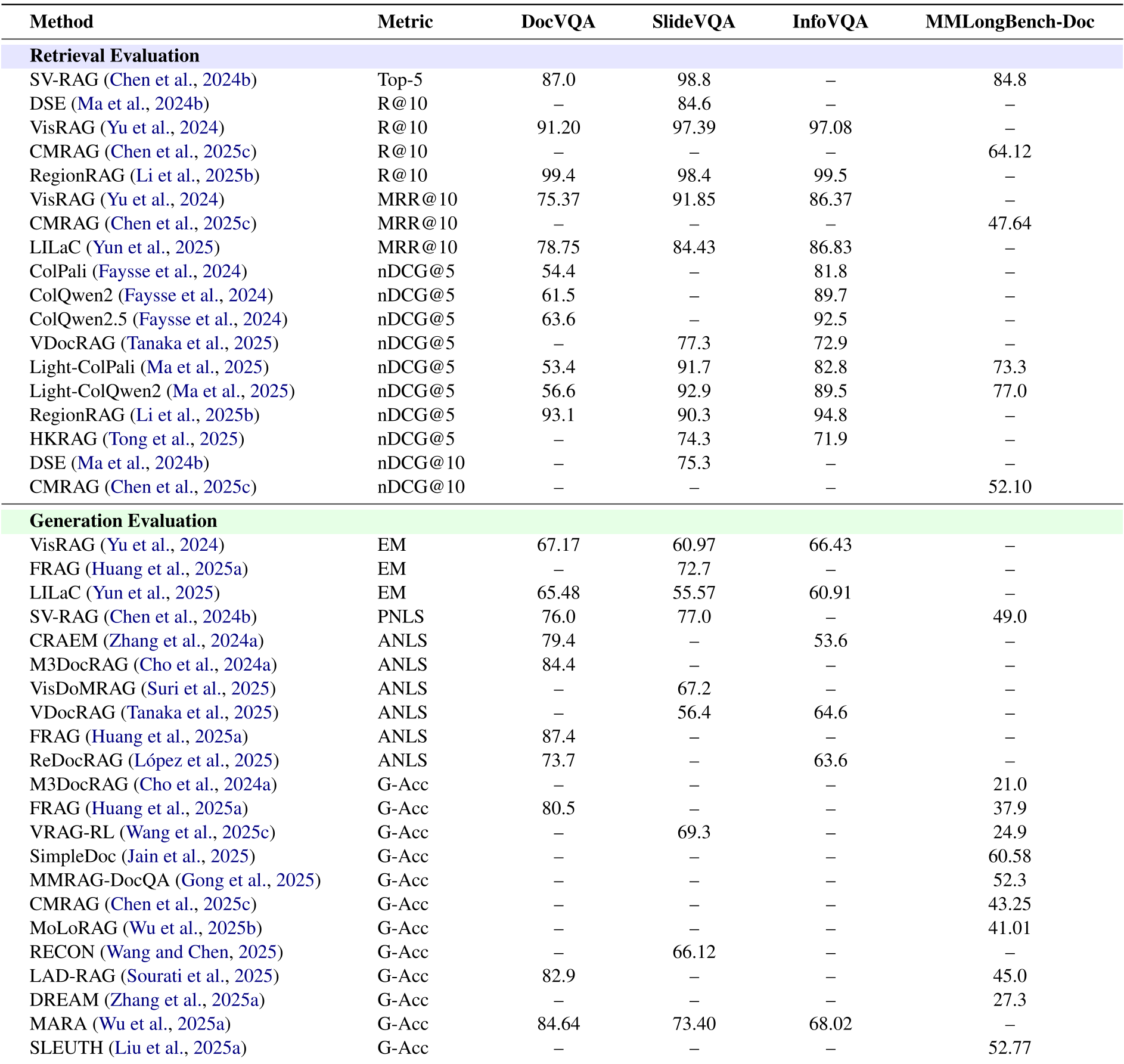 Table: Comparison of SOTA M-RAG methods. Note the surge in nDCG and G-Acc metrics.
5. Industrial Deployment: The Real-World Test
For industry (Finance, Healthcare, Law), the survey identifies Efficiency as the primary challenge.
- Token Compression: Storing raw visual tokens for millions of pages is too expensive.
- Optimized Tooling: The paper mentions tools like RAGFlow and LlamaIndex as essential for "Enterprise-grade" engines that need UI and production-ready pipelines.
6. Critical Analysis & Future Outlook
The survey isn't just a list of successes; it points out a "saturation" in current benchmarks.
- Limitation: We are reaching the limits of single-page VQA. We need more "Cross-document" benchmarks where information must be synthesized from multiple unrelated sources.
- Security: A new threat vector arises—Visual Knowledge Poisoning. An attacker could insert an adversarial chart that looks normal to humans but "tricks" the retriever into ignoring it.
Final Takeaway
Multimodal RAG is no longer an "extension" of NLP; it is a fundamental shift in Document AI. To build truly intelligent systems, we must treat layout and vision as first-class citizens, moving from "reading text" to "understanding documents as visual interfaces."