
[Journal of Informetrics] The Anatomy of Innovation: Measuring Scientific Novelty through Question-Method Combinations
Combination of research questions and methods: A new measurement of scientific novelty
Summary
Problem
Method
Results
Takeaways
Abstract
This paper proposes a novel framework for measuring scientific novelty by analyzing the combinations of research questions and research methods using a "Life-index" (frequency/age) and deep learning-based semantic representation (BERT). Evaluated on 204,224 ACM Digital Library papers, the study introduces a granular way to quantify "newness" beyond traditional citation counts.
## Executive Summary
**TL;DR**: Researchers from Wuhan University and the University of Tennessee have moved beyond simple citation counting to measure scientific novelty. By decomposing papers into core **research questions** and **methods**, and applying **BERT-based semantic analysis**, they have created a high-precision metric that identifies whether a paper is truly breaking new ground or just rebranding old ideas.
**Academic Positioning**: This work bridges the gap between "Science of Science" (SciSci) and Natural Language Processing (NLP). It refines the "Recombinational Novelty" theory by focusing on functional units rather than traditional keyword co-occurrence.
## The Motivation: Why Citations Lie
For decades, the "Impact Factor" and citation counts have been the gold standard for novelty. However, as the authors point out, citations are noisy: they measure popularity and "high risk/high reward" outcomes, but they don't necessarily reflect the **inherent newness** of a discovery. A paper might be highly cited because it applies a well-known method to a well-known problem (incremental work), while a truly novel atypical combination might face "delayed recognition."
The core insight of this paper is that scientific progress is essentially a **recombination process**. To measure it, we must ask:
1. Is the *problem* new?
2. Is the *method* new?
3. Is the *pairing* of this problem and method new?
## Methodology: Life-Cycles and Semantic Spaces
The authors propose a dual-track approach to quantify novelty:
### 1. The Life-indexNovelty (Temporal Frequency)
This metric focuses on the "age" of a term. If a research question has existed since 1970 (e.g., "Wireless Sensor Networks"), its novelty score drops. The formula uses the **Potential Development Year (PDY)** and frequency to calculate its "Life-index."
### 2. Semantic Novelty (Deep Learning)
This is the "Black Box" made transparent. Using a **BERT-based architecture**, the researchers map terms into a high-dimensional vector space.
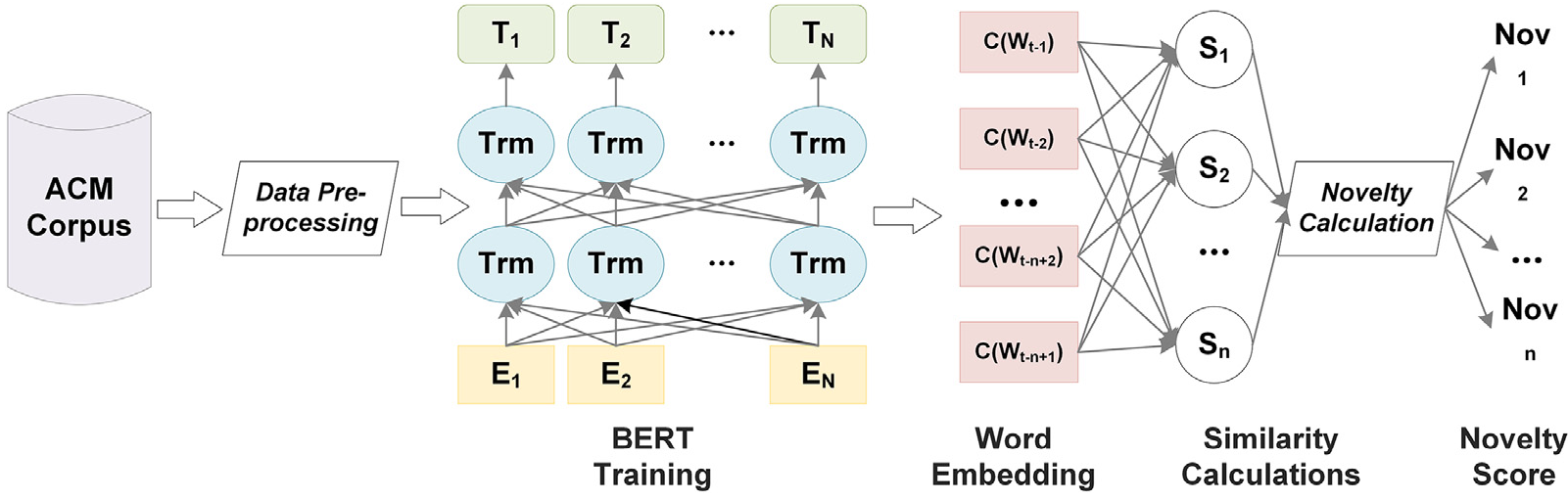
As shown in the architecture above, the system doesn't just look for literal word matches. It calculates the **Cosine Similarity** between current embeddings and the entire historical corpus. This allows the model to detect "Semantic Novelty"—identifying when an author uses new terminology for old concepts or truly introduces a method never before seen in a specific problem context.
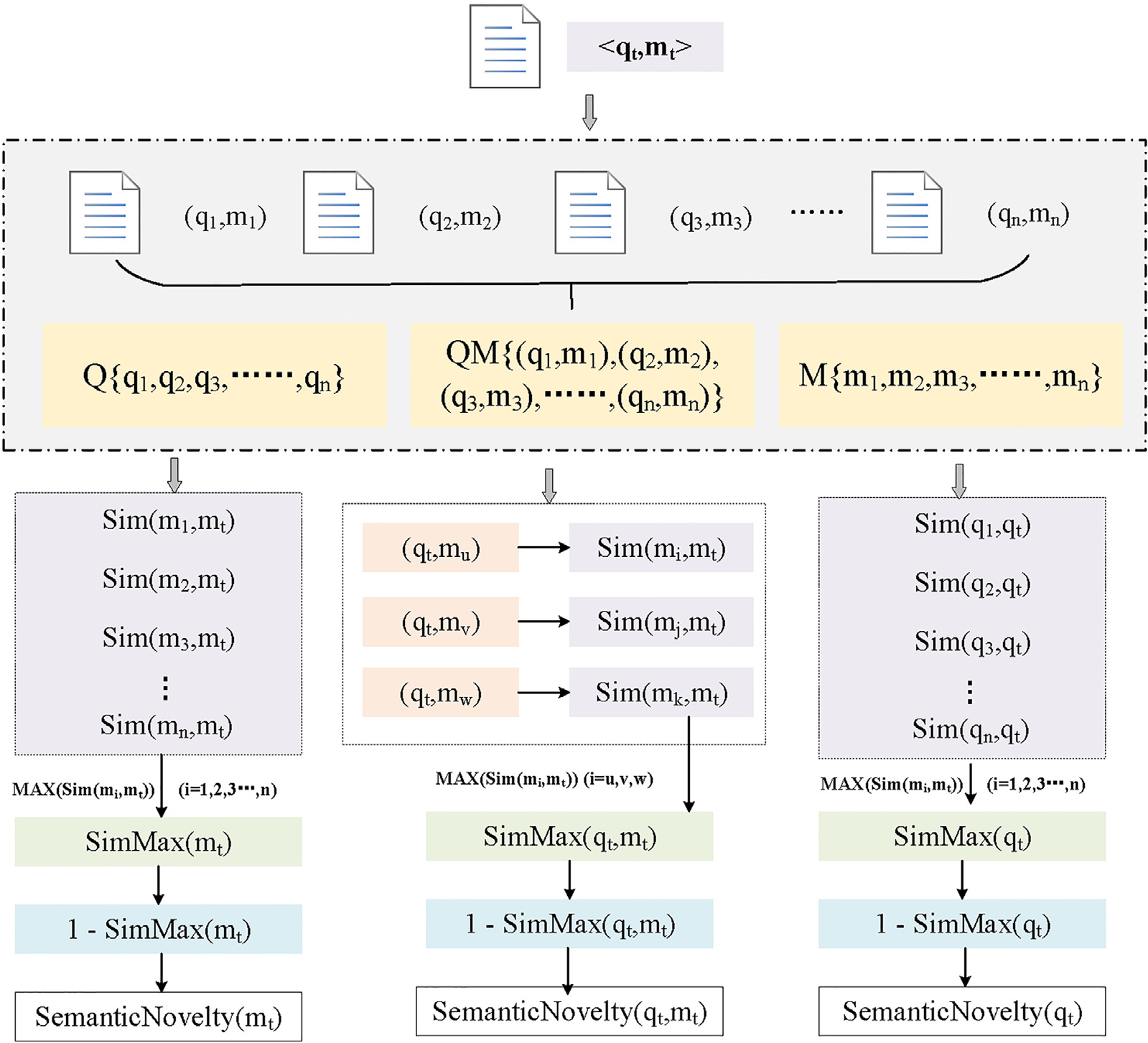
## Experimental Insights: The State of Computer Science
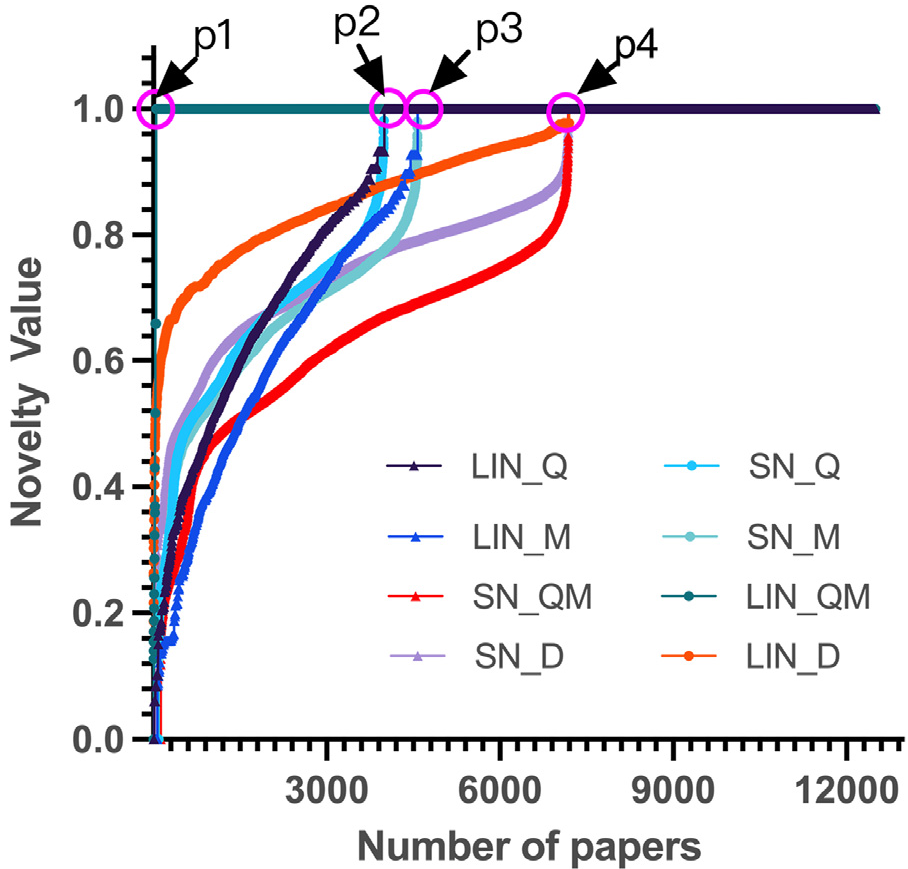
The team analyzed over 200,000 papers from the ACM Digital Library. Their "SOTA" comparison between the Life-index and Semantic methods showed that the **Semantic approach is far superior at capturing nuances**.
### Key Findings:
* **Innovation Distribution**: In 2018, **42.39%** of papers were "New Question + New Method." This confirms that Computer Science is a highly dynamic field with rapid "self-renewal."
* **The "Old-Old" Rareness**: Only **0.38%** of papers used an old question and an old method in a way that had been seen before. The ACM community significantly penalizes pure replication without new combinations.
* **Impact Correlation**: Papers categorized as "New Question + New Method" (e.g., DNN Accelerators using Maeri programming) received significantly higher citation counts.
## Critical Analysis & Conclusion
**Takeaway**: The value of this research lies in its **granularity**. Instead of saying "this paper is 80% novel," we can now say "this paper applies a SOTA Transformer method (old/standard now) to a highly novel problem in Agricultural IoT (new), making the *combination* highly innovative."
**Limitations**:
* **Disciplinary Bias**: The method relies on clear "Question" and "Method" definitions, which are distinct in Computer Science but may be "fuzzy" in Social Sciences or Humanities.
* **Core Term Extraction**: The model currently assumes one core question and one core method. In reality, large-scale systems (like GPT-4 papers) involve dozens of hybridized methods.
**Future Outlook**:
This framework could potentially be integrated into peer-review systems to help editors identify "Groundbreaking" versus "Incremental" research during the submission phase, effectively predicting future academic impact before the first citation even arrives.