
ClarityDX Prostate: Refining Cancer Screening Through Machine Learning and Flexible Data Inputs
Predicting clinically significant prostate cancer with or without digital rectal exam and MRI data using ClarityDX Prostate models
This study develops and validates ClarityDX Prostate, an ensemble of calibrated random forest models designed to predict clinically significant prostate cancer (csPCa, grade group ≥2). Using clinical features like PSA and age, with optional MRI (PI-RADS, volume) and DRE data, the models achieved high diagnostic accuracy with ROC AUC values up to 0.88, significantly outperforming 13 existing risk calculators.
TL;DR
Researchers have developed ClarityDX Prostate, a suite of machine learning models that significantly improve the detection of clinically significant prostate cancer (csPCa). By utilizing standard lab results and optional MRI or DRE data, these models achieve an ROC AUC of up to 0.88, outperforming 13 existing risk calculators and potentially reducing unnecessary biopsies by up to 44%.
Background: The Specificity Crisis in Prostate Cancer
Prostate-specific antigen (PSA) testing saved lives through early detection, but its lack of specificity created a secondary crisis: overdiagnosis. Many men undergo invasive biopsies—carrying risks of infection and hospitalization—only to find indolent, non-threatening tumors.
While MRI (mpMRI) and Digital Rectal Exams (DRE) improve accuracy, they aren't always available or consistently performed. The motivation for this study was to create a "flexible" diagnostic tool that provides SOTA accuracy whether a clinic has access to high-end imaging or just basic blood work.
Methodology: Calibrated Random Forests
The researchers didn't just build one model; they built four, tailored to the data available at the point of care:
- Base Model: (Age + PSA + Free PSA Ratio + Prior Biopsy)
- +DRE: Adding physical exam findings.
- +MRI: Adding PI-RADS scores and prostate volume.
- Full Model: Combining all available clinical inputs.
At the heart of ClarityDX is an ensemble of random forest models calibrated with isotonic regression. This ensures that the risk percentage output by the model aligns with real-world probability.
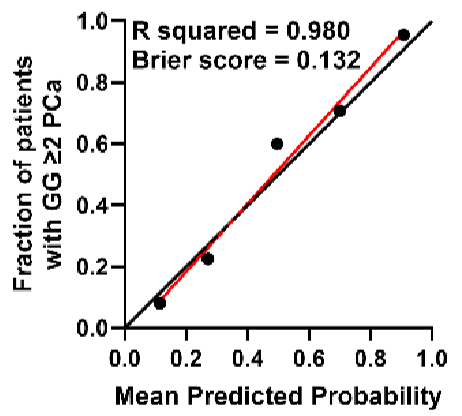 Figure 1: Calibration curves showing tight alignment between predicted and observed risk across different institutional cohorts.
Understanding the "Black Box" via SHAP
To ensure clinical trust, the authors used SHAP (SHapley Additive exPlanations) values to see which features moved the needle.
- MRI Impact: When available, PI-RADS and Prostate Volume were the most dominant predictors.
- The Biomarker Edge: Interestingly, the Free PSA Ratio proved more influential than total PSA, justifying its inclusion in the panel despite being underutilized in some clinics today.
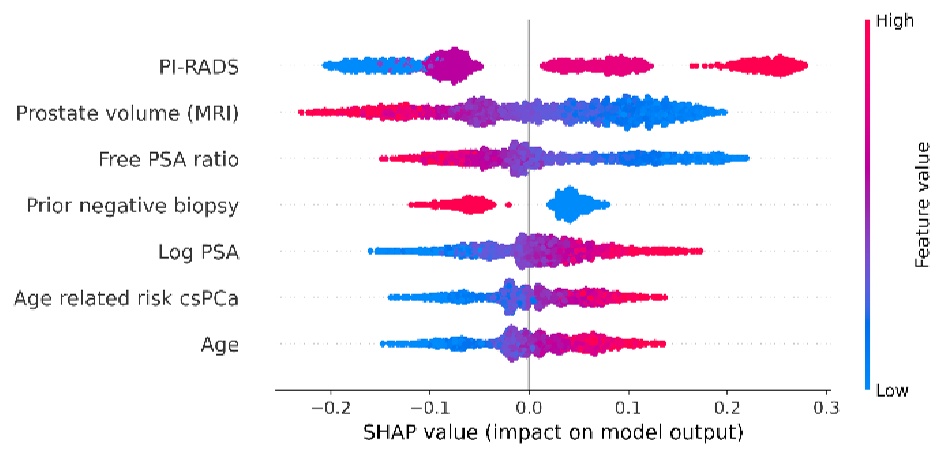 Figure 2: SHAP analysis revealing how individual features like PI-RADS 4/5 (positive impact) and high Free PSA Ratio (negative impact) drive the final risk score.
Experimental Results: Setting a New SOTA
The study compared ClarityDX against a "Who's Who" of clinical risk calculators (e.g., PCPTRC, PBCG, ERSPC).
Key Benchmarks:
- Benchmarking: ClarityDX (Total AUC ~0.81-0.88) consistently beat the 13 public calculators in head-to-head validation.
- Biopsy Avoidance: At a 95% sensitivity threshold (ensuring few cancers are missed), the model could help avoid 44% of unnecessary biopsies when MRI is used.
- Clinical Utility: The models are 2.3 to 3.4 times more accurate than the traditional PSA-only approach.
Critical Insight: The DRE Paradox
One of the study's most interesting takeaways is the diminishing value of the DRE when MRI data is present. The SHAP value for DRE effectively halved in models that included MRI. This suggests that for modern urology practices using mpMRI, the "stigmatized" physical exam might add surprisingly little diagnostic value, potentially paving the way for a better patient experience without sacrificing safety.
Conclusion & Future Outlook
ClarityDX Prostate represents a significant step toward personalized diagnostic pathways. Its ability to maintain high performance across international cohorts (Canada, USA, Czechia) suggests strong generalizability.
Future Work: The authors note a need for more ethnic diversity in validation—particularly increasing the representation of Black/African American participants—to ensure the model's "fairness" and accuracy across all populations.
Takeaway: In the near future, the decision to biopsy may not rest on a single doctor’s intuition or a single PSA number, but on a calibrated machine learning consensus.