
Neoadjuvant Therapy in CRCPOM: Shifting the Paradigm from Upfront Surgery to Risk-Stratified Management
Neoadjuvant therapy for resectable colorectal cancer pulmonary oligometastases: a retrospective cohort study
This retrospective cohort study evaluates the efficacy of Neoadjuvant Therapy (NAT) for patients with resectable Colorectal Cancer Pulmonary Oligometastases (CRCPOM). Using Propensity Score Matching (PSM), the study demonstrates that NAT significantly improves Disease-Free Survival (DFS) and Overall Survival (OS), achieving a Hazard Ratio (HR) of 0.52 for DFS post-matching.
TL;DR
A retrospective analysis of 253 patients reveals that Neoadjuvant Therapy (NAT) significantly improves Disease-Free Survival (DFS) in patients with resectable colorectal cancer lung metastases, provided they exhibit high-risk clinical features. The study introduces a practical 4-point risk score to identify who should receive chemo before the scalpel, potentially standardizing a previously ambiguous area of oncology.
The "Lungs vs. Liver" Dilemma
In the world of metastatic colorectal cancer (mCRC), liver metastases have well-established protocols incorporating perioperative chemotherapy (e.g., the EORTC 40983 trial). However, the pulmonary (lung) oligometastasis has remained a "gray zone." While surgeons often favor upfront lung metastasectomy, the high recurrence rates (historical 5-year DFS around 24-68%) suggest that local treatment alone is often insufficient.
The core problem? Adjuvant (post-operative) chemotherapy has repeatedly failed to show survival benefits in CRCPOM trials. This research asks: Can we move the therapy before surgery (Neoadjuvant) to weed out aggressive disease and eradicate micrometastases?
Methodology: Precision through Risk Stratification
The researchers didn't just compare NAT vs. Surgery; they sought to understand why some patients benefit more than others. They identified four "red flags" for recurrence:
- Elevated CEA (>5.0 ng/mL): Indicating high tumor burden.
- Short DFI (<2 years): Signaling an aggressive, fast-moving cancer.
- Lymph Node Positive Primary: Evidence of early systemic spread.
- Extrapulmonary Metastases: Evidence that the disease is not localized to the lungs.
The Model
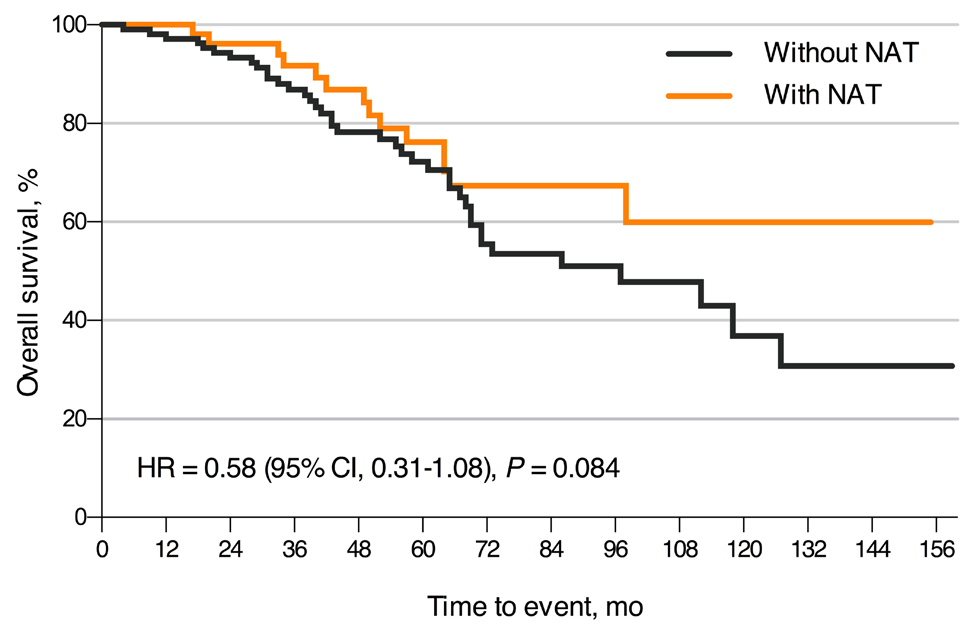
By applying Propensity Score Matching (PSM), the authors ensured that the comparison between the NAT group and the surgery-only group was not biased by the fact that "sicker" patients are often naturally steered toward chemotherapy.
Key Findings: The Power of the "Responders"
The study’s results are a powerful endorsement of NAT for specific subgroups:
- Survival Boost: NAT reduced the risk of recurrence/death by 48% (HR 0.52) in the matched cohort.
- The Threshold of Zero: Patients with zero risk factors (Low Risk) had a 5-year DFS of ~80% regardless of whether they had NAT. For them, surgery alone is enough.
- The Benefit of NAT: In Moderate and High-risk groups (1-4 factors), NAT significantly pushed the DFS curve upward.
- The RECIST Signal: If a tumor shrank during NAT (CR/PR), the patient's prognosis improved dramatically (HR 0.31). This confirms that NAT acts as a "biological test"—if the tumor doesn't respond to chemo, surgery might be a futile local solution for a systemic problem.
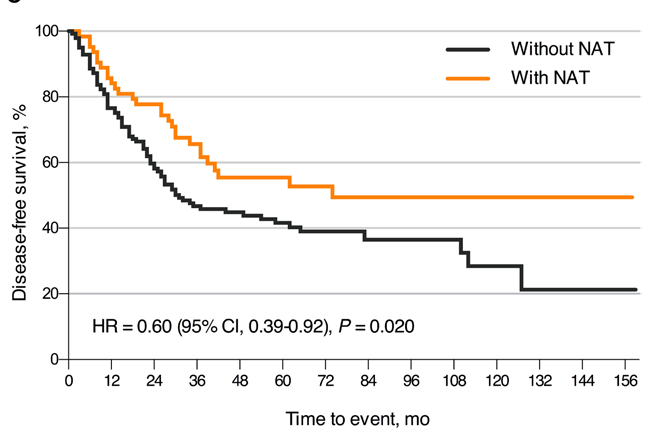
Critical Insight & Outlook
This paper provides much-needed evidence that NAT should be the preferred starting point for CRCPOM patients with high clinical risk.
The Takeaway: We should stop viewing lung metastasectomy as a purely mechanical task of "removing spots." Instead, using NAT allows clinicians to:
- Assess Biology: Only proceed with surgery if the disease is stable or responding.
- Clear the Field: Kill micrometastases that the CT scan can't see.
Limitations: As a retrospective study, there is still the risk of "immortal time bias" and heterogeneity in chemo regimens (though most used Oxaliplatin-based stacks). Moving forward, we need randomized control trials (RCTs) to validate this Clinical Risk Score as a standard tool for the MDT (Multidisciplinary Team) meeting.
Conclusion
For the modern oncologist, the message is clear: Check the score before you cut. If the patient has even one risk factor, neoadjuvant therapy isn't just an option—it’s likely the key to long-term survival.