
From Reasoning to Autonomy: Navigating the 2025 AI Agent Frontier
From LLM Reasoning to Autonomous AI Agents: A Comprehensive Review
This paper provides a comprehensive review of the rapid transition from Large Language Model (LLM) reasoning to Autonomous AI Agents (Agentic AI). It introduces a systematic taxonomy of approximately 60 benchmarks developed between 2019 and 2025, surveys key agent frameworks (LangChain, LlamaIndex, CrewAI), and analyzes emerging inter-agent communication protocols like ACP, MCP, and A2A.
TL;DR
The AI industry is moving beyond the "chatbot" era toward Autonomous AI Agents. This comprehensive survey summarizes the state of the art between 2019 and 2025, revealing that while LLMs are mastering language, they still struggle with expert-level reasoning and autonomous action. The report highlights the critical role of new communication protocols (MCP, A2A) and the emergence of "Agentic RAG."
The "Agentic Gap": Why Logic Isn't Enough
Despite the hype surrounding models like GPT-4o and DeepSeek-R1, there remains a massive gap between knowledge and utility. The survey introduces the Humanity's Last Exam (HLE) benchmark, where SOTA models score under 10%.
The Problem: Current models rely on static pre-training. When faced with multi-step tools or creative problem-solving (like the ENIGMAEVAL puzzles), their performance collapses. The industry's solution? Agentic Workflows.
Methodology: The Anatomy of an AI Agent
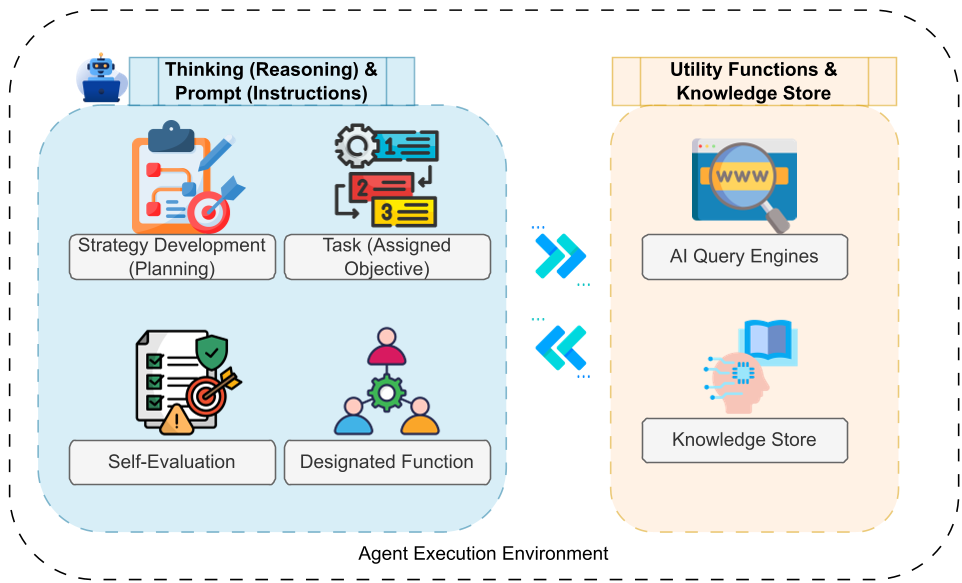
The survey breaks down the modern agent into four core elements:
- Planning: Breaking complex objectives into sub-tasks (e.g., ReAct, Tree of Thoughts).
- Memory: Utilizing short-term context and long-term vector stores (RAG).
- Action: Using toolkits (APIs, code execution) to affect the real world.
- Communication: Using standardized protocols to talk to other agents.
Agentic RAG vs. Traditional RAG
While traditional RAG simply fetches data, Agentic RAG introduces a loop:
- Self-Correction: The agent evaluates if the retrieved data is relevant.
- Decomposition: The agent breaks down the user query into multiple search steps.
- Iterative Refinement: The agent keeps searching until the gap in knowledge is closed.
Frameworks and Collaboration Protocols
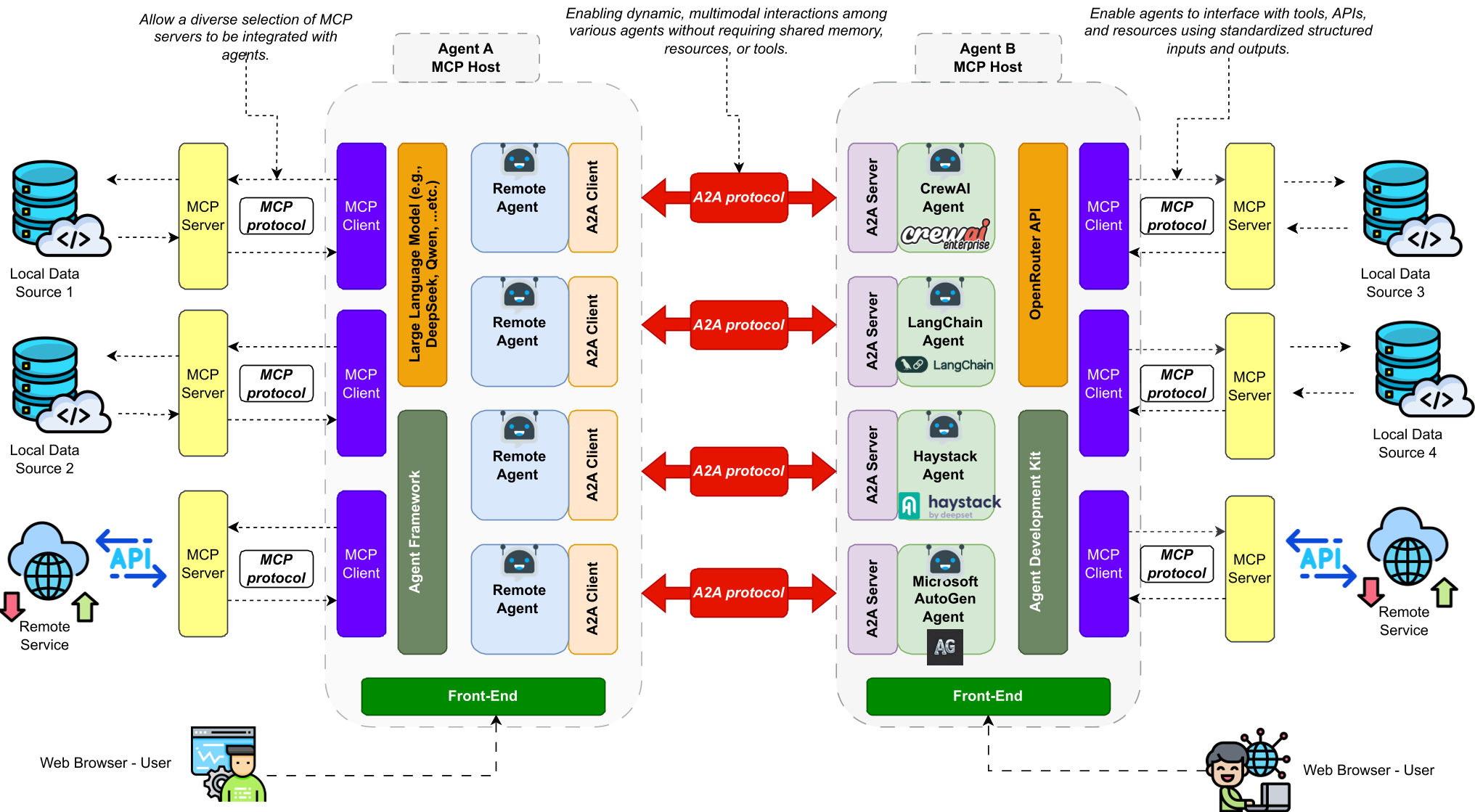
The survey highlights a battle for the "Universal Connection Port" of AI:
- MCP (Model Context Protocol): Introduced by Anthropic, it acts like a "USB-C" for AI, allowing models to connect to any data source (GitHub, Slack, Databases) via a standard interface.
- A2A (Agent-to-Agent): Google's protocol for enabling dynamic collaboration between agents from different vendors (e.g., a CrewAI agent talking to a LangChain agent).
Real-World Impact: Biology to Finance
The report details specialized agents that are already specialized:
- BioScience: GeneAgent uses self-verification to minimize hallucinations in functional genomics.
- Software Engineering: SWE-Gym and AgentGym are training agents to fix bugs autonomously, pushing pass rates to over 50% through "test-time compute scaling."
- Finance: FinCon and TwinMarket simulate socio-economic systems, capturing irrational human behaviors and emotional biases in market simulations.
Critical Insight: The "Multi-Agent" Failure Modes
Why do multi-agent systems often fail despite the "wisdom of the crowd"? The authors identify 14 failure modes, including:
- Inter-agent misalignment: Agents ignoring specific role constraints.
- Endless loops: Redundant repetitions without progressing toward the goal.
- Verification Lapses: Failed agents incorrectly reporting "Task Complete."
Future Outlook
The road to Artificial General Intelligence (AGI) lies in solving System 2 Reasoning—the slow, deliberate thinking required for complex tasks. We should expect future research to focus on:
- Automated Scientific Discovery: AI "Co-Scientists" generating and ranking their own hypotheses.
- Dynamic Tool Integration: Agents learning to use unseen tools via Reinforcement Learning.
- Security: Hardening protocols (MCP/A2A) against prompt injections and protocol exploits.
Conclusion
We are moving from "asking an AI a question" to "giving an AI a job." This survey provides the essential coordinates for anyone building at the frontier of Agentic AI.