
Knowledge Distillation: Bridging the Gap Between Cumbersome Giants and Edge Efficiency
Knowledge Distillation: A Survey
This paper provides a comprehensive survey of Knowledge Distillation (KD), a key model compression technique where a small "student" model is trained to mimic a large "teacher" model. It categorizes the field into knowledge types (response, feature, relation), distillation schemes (offline, online, self), and architectures, highlighting its effectiveness across CV, NLP, and Speech tasks.
Executive Summary
TL;DR: This foundational survey deconstructs Knowledge Distillation (KD)—the art of transferring "intelligence" from massive, billion-parameter teacher models to compact, deployable student networks. It maps out the transition from simple logit-matching to complex relational and adversarial learning.
Positioning: This is a domain-defining survey that organizes a decade of research into a structured taxonomy. It shifts the perspective of KD from a mere compression tool to a fundamental learning strategy applicable to nearly every AI sub-field.
Problem & Motivation: The Deployment Paradox
The modern AI era is defined by a paradox: to gain accuracy, we increase model depth and width (the "Giant" models), but to gain utility, we must shrink them for mobile phones and IoT devices.
Prior Work Limitations:
- Parameter Pruning: Often breaks structural integrity.
- Quantization: Can lead to significant precision loss without proper retraining.
- The Missing Link: These methods ignore the "functional" knowledge—the internalized logic—that a trained model possesses.
The authors argue that a teacher model's soft predictions contain "Dark Knowledge" (inter-class similarities) that is far more informative than hard labels alone.
Methodology: The Three Pillars of KD
The survey breaks down KD into three distinct dimensions that define any distillation system:
1. The "What": Knowledge Categories
- Response-Based: Mimicking the final output (logits). This teaches the student what the teacher decided.
- Feature-Based: Mimicking intermediate layers (activations/hints). This teaches the student how the teacher perceives features.
- Relation-Based: Mimicking the relationships between different data samples or layers. This captures the manifold structure of the data.
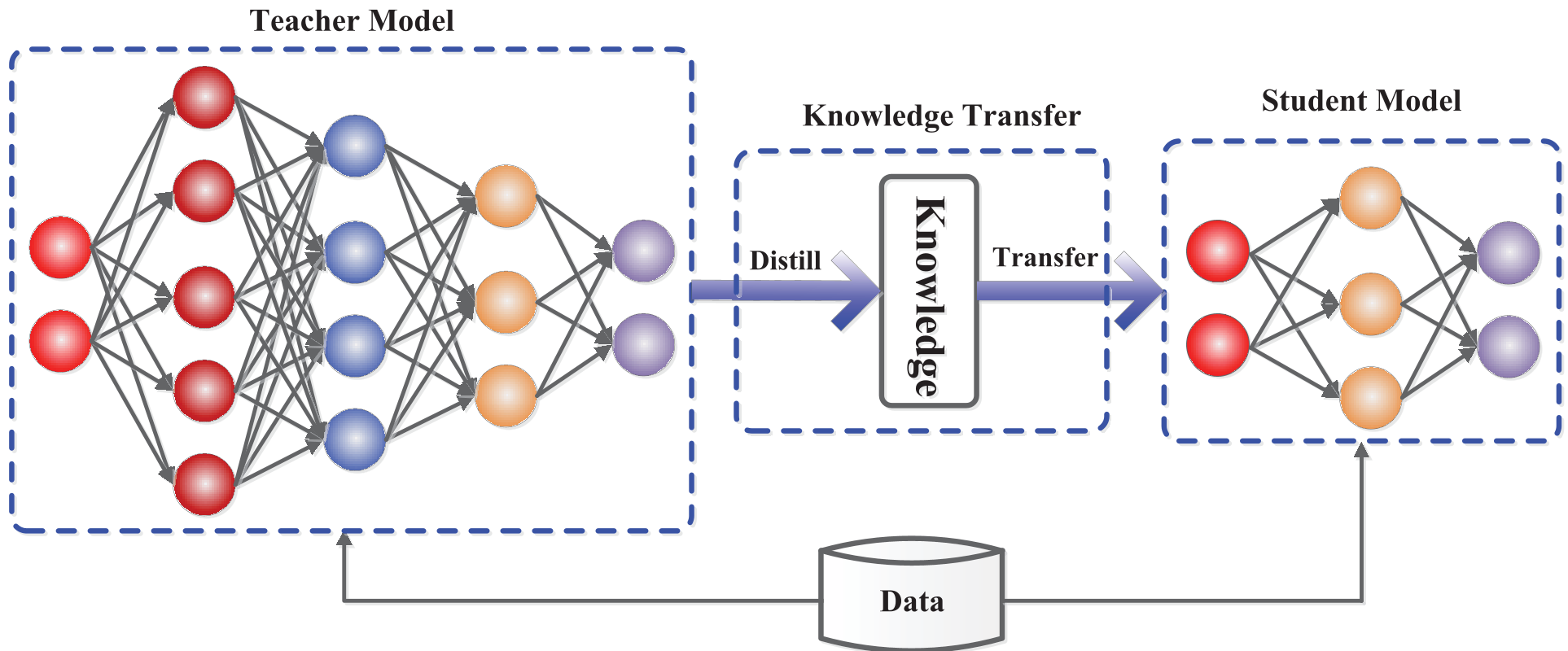 Fig 1: The general teacher-student framework showing the flow of knowledge transfer.
2. The "When": Distillation Schemes
- Offline: The teacher is pre-trained and legacy. Simple, but suffers from a "capacity gap" where the student can't keep up.
- Online: Teacher and student learn together. This is a collaborative "study group" approach (e.g., Deep Mutual Learning).
- Self-Distillation: The model acts as its own teacher, using deeper layers to guide shallower ones.
3. The "How": Distillation Algorithms
The authors highlight Adversarial Distillation (GAN-based) as a major trend. By using a discriminator, the student is forced to produce outputs that are indistinguishable from the teacher's, effectively "fooling" the evaluator into thinking it is a high-capacity model.
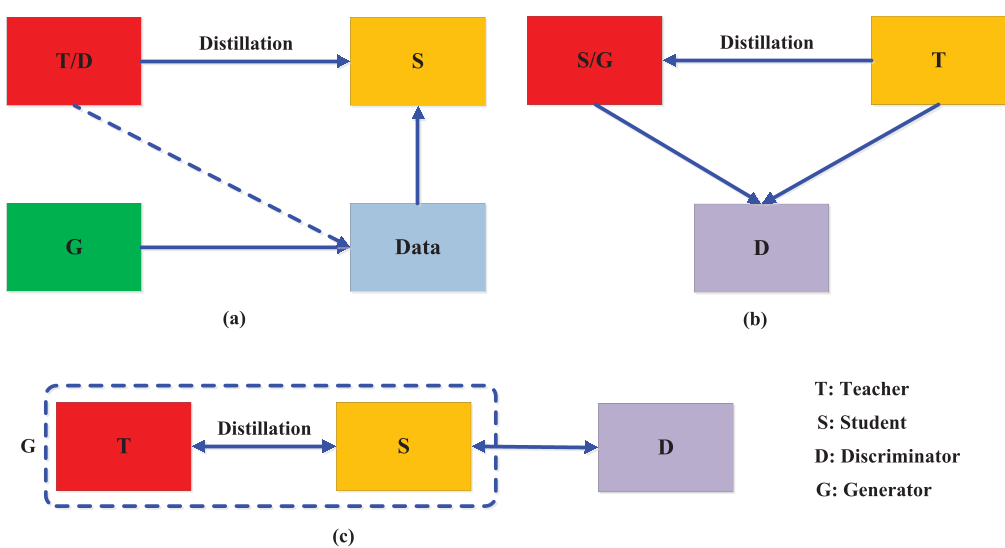 Fig 2: Taxonomy of Adversarial Distillation architectures.
Experiments & Results: Quantitative Triumphs
The survey compiles extensive results across CIFAR datasets. The most striking takeaway is that Feature-Based and Relation-Based knowledge often yield higher gains for very thin networks compared to simple Response-Based methods.
| Method | Teacher (Acc) | Student (Acc) | Gain |
|---|---|---|---|
| TOFD | ResNet152 | ResNet50 (77.42) | +7.32% |
| SemCKD | ResNet-32x4 | VGG13 (74.82) | +4.61% |
| DML (Online) | MobileNet | ResNet32 | +8.11% |
These numbers prove that a student doesn't just "match" a teacher; with the right distillation loss—specifically those targeting internal representations—the student can significantly outperform its standalone training.
Critical Analysis & Conclusion
Takeaway: KD is the "software" solution to a "hardware" problem. By transferring the Inductive Bias of a large model, we can bypass the expensive parts of the optimization landscape for the student.
Limitations:
- Teacher Dependence: A "bad" teacher (or one too far advanced beyond the student's capacity) can actually hurt performance.
- Theoretical Vacuum: We know that it works, but a rigorous PAC-learning understanding of why specific intermediate layers are better "hints" than others is still developing.
Future Outlook: The next frontier lies in Data-Free Distillation (for privacy) and NAS-Based Distillation, where the student's architecture is automatically evolved to best soak up a specific teacher's knowledge.