
The LLM Blueprint: Decoding the Architecture and Evolution of Giant Models
A Comprehensive Overview of Large Language Models
A comprehensive survey of Large Language Models (LLMs) titled "A Comprehensive Overview of Large Language Models," covering architectural evolutions (from T5 to Llama-3), training strategies, and adaptation paradigms. It synthesizes insights from hundreds of papers to map the transition from Pre-trained Language Models (PLMs) to the current SOTA frontier.
TL;DR
The LLM field has moved from "bigger is better" to "smarter scaling." This comprehensive overview analyzes the lineage of models from GPT-3 to Llama-3.1, revealing that architectural stability, data quality (LIMA), and efficient attention mechanisms (Flash/MLA) are now as critical as raw parameter counts.
Contextual Positioning
LLMs are no longer just an NLP curiosity; they are the "cognitive controllers" of the next tech stack. This work identifies that the field has consolidated around the Causal Decoder architecture while branching into three critical optimization fronts: Instruction-tuning, Efficiency (Quantization/PEFT), and Tool Augmentation.
Problem & Motivation: The Complexity Wall
As models hit the trillion-parameter mark (e.g., PanGu-Σ), the primary bottleneck shifted from simple GPU memory to "Memory Bandwidth" and "Communication Overhead." The survey identifies that traditional Post-LayerNorm Transformers were unstable at scale, leading the industry toward Pre-RMSNorm and Rotary Positional Embeddings (RoPE) to maintain training sanity.
Methodology: The Seven Pillars of LLM Design
The authors decompose LLM development into a systematic pipeline:
- Pre-training: Defining the objective (Causal vs. Unified).
- Fine-tuning: Transitioning from zero-shot to instruction-aware behavior.
- Efficiency: Using Low-Rank Adaptation (LoRA) and 4-bit quantization (QLoRA) to make 70B models run on consumer hardware.
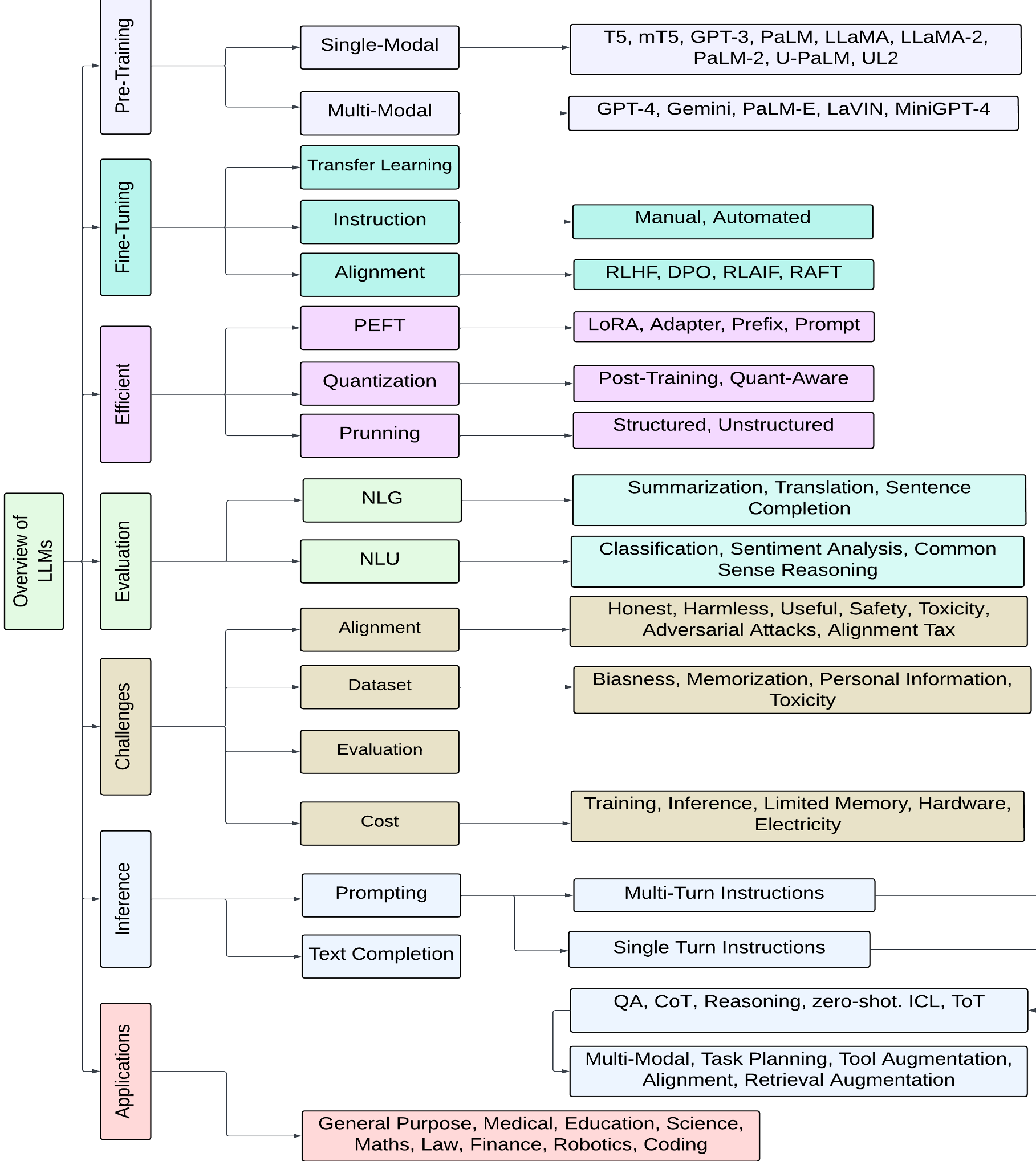 Figure 3: A hierarchical breakdown of the LLM ecosystem, highlighting the transition from base models to applied agents.
The Core Insight: Why Mixture of Experts (MoE)?
The survey sheds light on the surge of MoE models (like Mixtral and DeepSeek-v2). By activating only a fraction of "experts" for each token, models like GLaM (1.2T parameters) consume only 1/3 of the training energy of GPT-3 while maintaining superior performance. This represents a paradigm shift from "Dense" to "Sparse" computation.
Key Findings: The "Small Model" Counter-Revolution
One of the most profound takeaways is the performance of Tk-Instruct (11B). Despite being orders of magnitude smaller than GPT-3, its specialized instruction-tuning allows it to outperform the 175B giant on specific cross-task generalizations. This proves that task-specific data diversity is a more potent signal than sheer model volume.
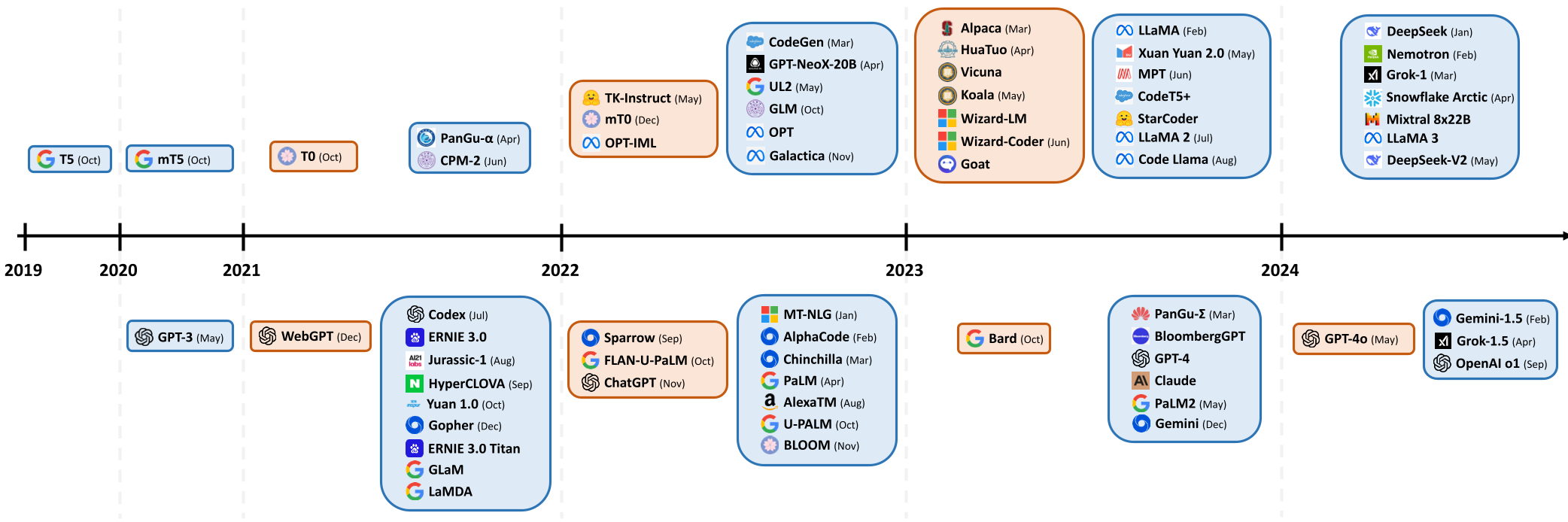 Figure 2: The chronological explosion of open-source (blue) vs. closed-source (orange) models, showing the rapid maturation of the Llama ecosystem.
Critical Analysis & Future Outlook
While the survey is exhaustive, it highlights persistent "Dark Clouds":
- Hallucination: Even the best aligned models (Llama-2-Chat) suffer from fact-conflicting outputs.
- Context Windows: While Gemini 1.5 reaches 2M+ tokens, the quadratic cost of standard Attention remains a hurdle, driving interest in Linear Attention or SSMs.
- Security: The "Black Box" nature makes them vulnerable to prompt injection and data poisoning.
Conclusion
The next frontier isn't just language; it's Embodied AI. As LLMs integrate with robotics (PaLM-E) and professional tools (BloombergGPT), the focus will shift from "predicting the next token" to "executing the next safe action." For researchers, the message is clear: data cleaning and architectural efficiency are the new SOTA.