
Real Money, Fake Models: The Deceptive Reality of Shadow LLM APIs
2603.01919v2
This paper presents the first systematic audit of "Shadow APIs"—unauthorized third-party services claiming to provide access to frontier LLMs like GPT-5 and Gemini-2.5. By evaluating 17 shadow APIs across utility, safety, and identity verification, the study reveals widespread deceptive practices, including model substitution and significant performance degradation.
The rapid ascent of frontier models like GPT-5 and Gemini-2.5 has created a digital divide. High costs and geographic restrictions have pushed many researchers and developers toward the "Shadow API" market—third-party providers promising "official" performance at a fraction of the price.
But are you actually getting what you pay for? A new systematic audit reveals a disturbing trend of deception, model swapping, and capability collapse.
TL;DR
- The Shadow Market is Huge: 17 shadow APIs were found cited in 187 academic papers.
- Deception is Common: Nearly 46% of shadow API endpoints fail identity fingerprinting tests.
- Performance Collapse: In specialized fields like medicine, accuracy drops by nearly 50% compared to official sources.
- Unpredictable Safety: Shadow APIs fail to replicate the safety guardrails of official models, showing inconsistent jailbreak resilience.
The "Lure" of the Shadow API
Shadow APIs function as black-box agencies. They route requests through unauthorized nodes, often in violation of both service contracts and regional regulations. Researchers often treat these as interchangeable substitutes for official APIs, focusing on cost and access while ignoring the supply chain risks.
Methodology: How to Catch a Fake Model
The authors didn't just look at accuracy; they looked at the "DNA" of the model responses.
- Capability Testing: Using benchmarks like MedQA (Medical) and LegalBench (Legal) to detect reasoning shortcuts.
- Active Fingerprinting (LLMmap): Probing models with specific queries to see if their output distributions match known architectures.
- Statistical Auditing (MET): Using Model Equality Testing to determine if shadow API outputs are drawn from the same distribution as official ones.
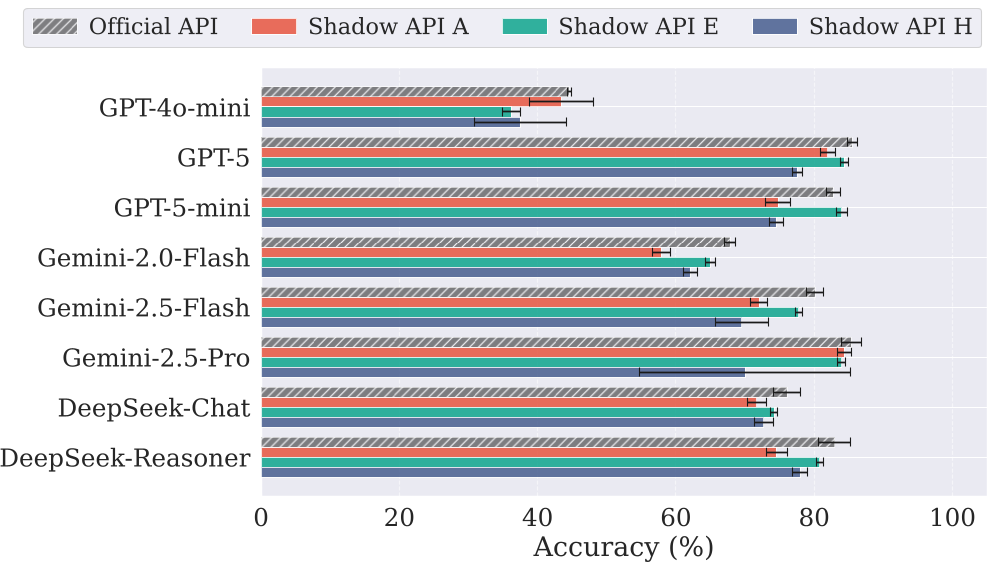 Figure: Even in science domains, shadow APIs (A and H) show pronounced divergences from official benchmarks.
Key Findings: The Cost of Deception
1. The Reasoning Collapse
While shadow APIs might perform adequately on simple chat tasks, they fail miserably when "reasoning" is required. On the MedQA benchmark, the Gemini-2.5-flash model's accuracy plummeted from 83.82% (Official) to a staggering 37.0% on shadow platforms. This suggests that hidden, cheaper, and less capable models are being used as "stunt doubles" for frontier models.
2. Identity Fraud
Using LLMmap, the researchers found that many "GPT-5" endpoints actually responded like GLM-4 or DeepSeek-V3. This "Discount-Substitution" scheme allows providers to charge a premium for a high-end model while running a low-cost open-source model under the hood.
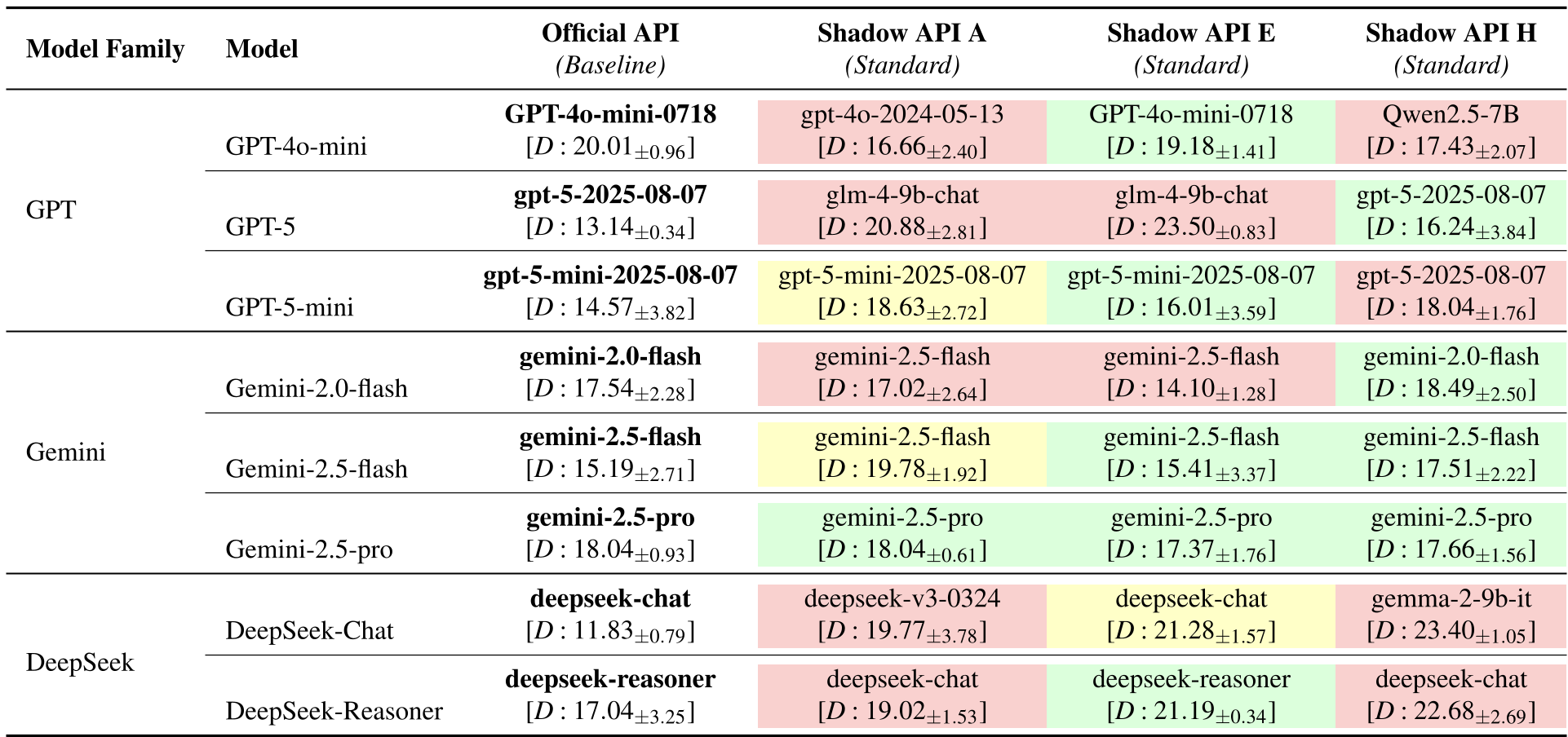 Table: Fingerprinting reveals blatant model mismatches, such as GPT-5 being swapped for GLM-4.
3. Safety and Reliability
Safety behaviors in shadow APIs were found to be wildly unpredictable. In some cases, harmfulness scores doubled (GPT-5-mini under Base64 attack), while in others, risks were underestimated. Furthermore, shadow APIs showed latency volatility often exceeding 2.0x the official baseline, indicative of unstable backend routing.
Deep Insight: The Reproducibility Crisis
The most alarming takeaway is the threat to science. The paper identifies 187 research works—many in top venues like ACL, CVPR, and ICLR—that relied on these shadow services. If the underlying model was a "fake," the experimental results of those papers are effectively invalid. The authors estimate the aggregate direct cost of re-running these corrupted experiments to be between 140,000.
Conclusion & Future Outlook
The shadow API market exploits information asymmetry. To safeguard AI research:
- Researchers must utilize a "Pre-Registration Checklist" and avoid shadow APIs for any publication-grade data collection.
- Auditors should implement the four-stage verification pipeline (LLMmap + MET + Volatility Check + Compliance).
- Model Providers (OpenAI, Google) need to address the root causes by relaxing geographic restrictions and offering academic tiers.
In the world of LLMs, if the price seems too good to be true, the model probably is too.
Summary Table of Deception Mechanisms:
| Mechanism | Deception Evidence |
|---|---|
| Information Premium | Charging 7x the price for a model that's actually a different version. |
| Discount-Substitution | Swapping a premium proprietary model (GPT-5) for a cheap open-source one. |
| Resale Markup | Silent substitution with a downgraded backend despite official-level pricing. |