
[arXiv 2025] Identifying the Next Big Idea: Harnessing LLMs for Scientific Novelty Detection
2505.24615v1
The paper introduces a novel framework for Scientific Novelty Detection (ND) by leveraging Large Language Models (LLMs) to overcome the gap between textual similarity and conceptual idea alignment. It presents two specialized benchmark datasets (Marketing and NLP) and proposes an LLM-based knowledge distillation (KD) method to train a lightweight retriever that identifies conceptually similar research ideas.
Executive Summary
TL;DR: Researchers from NTU, SUTD, and A*STAR have developed a framework that solves a critical flaw in AI-driven research: the inability to distinguish between a "newly worded" idea and a "conceptually new" one. By distilling LLM knowledge into a specialized retriever and using a "topologically closed" dataset, they’ve boosted the accuracy of novelty detection by over 20%.
Background Positioning: This work moves beyond simple "RAG for papers" and establishes a rigorous benchmark for Scientific Novelty Detection (ND). It sits at the intersection of Information Retrieval (IR) and AI-for-Science, specifically addressing the "innovation-disruption" paradox where scientific output grows while true novelty declines.
The "Paraphrase" Trap: Why Current Systems Fail
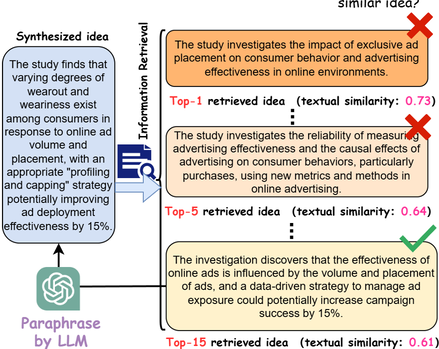
The core problem is the Textual vs. Conceptual Gap. If a researcher takes an existing paper and simply rewords the hypothesis, standard retrievers (like BGE or GTE) often fail to find the original source because the words have changed, even if the concept hasn't.
As shown in the paper's motivation, a paraphrased idea might have lower textual similarity to its source than a completely different idea that just happens to use similar keywords.
Methodology: Closing the Loop on Innovation
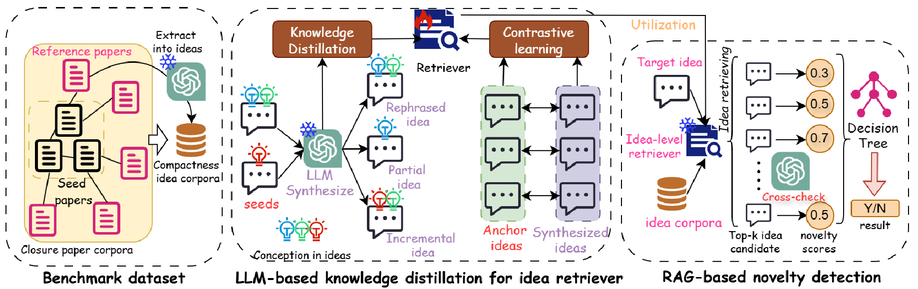
The authors propose a three-stage solution:
1. Topological Closure & Compactness
To detect novelty, you must have a "complete" view of the past. The authors built datasets in Marketing and NLP where for every "seed" paper, the entire reference tree is crawled (Topological Closure). They then use LLMs to condense these papers into "compact" structured hypotheses to remove noise.
2. Idea-Level Knowledge Distillation (KD)
The secret sauce is how they train the retriever. Instead of using standard labels, they use an LLM to generate three types of "non-novel" ideas from an anchor paper:
- Rephrased: Same idea, different words.
- Partial: A subset of the original claims.
- Incremental: A minor extension (the hardest to detect). They then use Contrastive Learning to force the retriever's embedding space to group these diverse expressions of the same concept together.
3. RAG-based Detection
Once the retriever finds the top-K most similar historical ideas, a Reasoning LLM (like DeepSeek-Reasoner) performs a fine-grained comparison and assigns a novelty score (0.0 to 1.0).
Experiments: Performance Leap
The framework (RAG-KD) was tested against standard baselines like SciMON and MOOSE-Chem.
Key Findings:
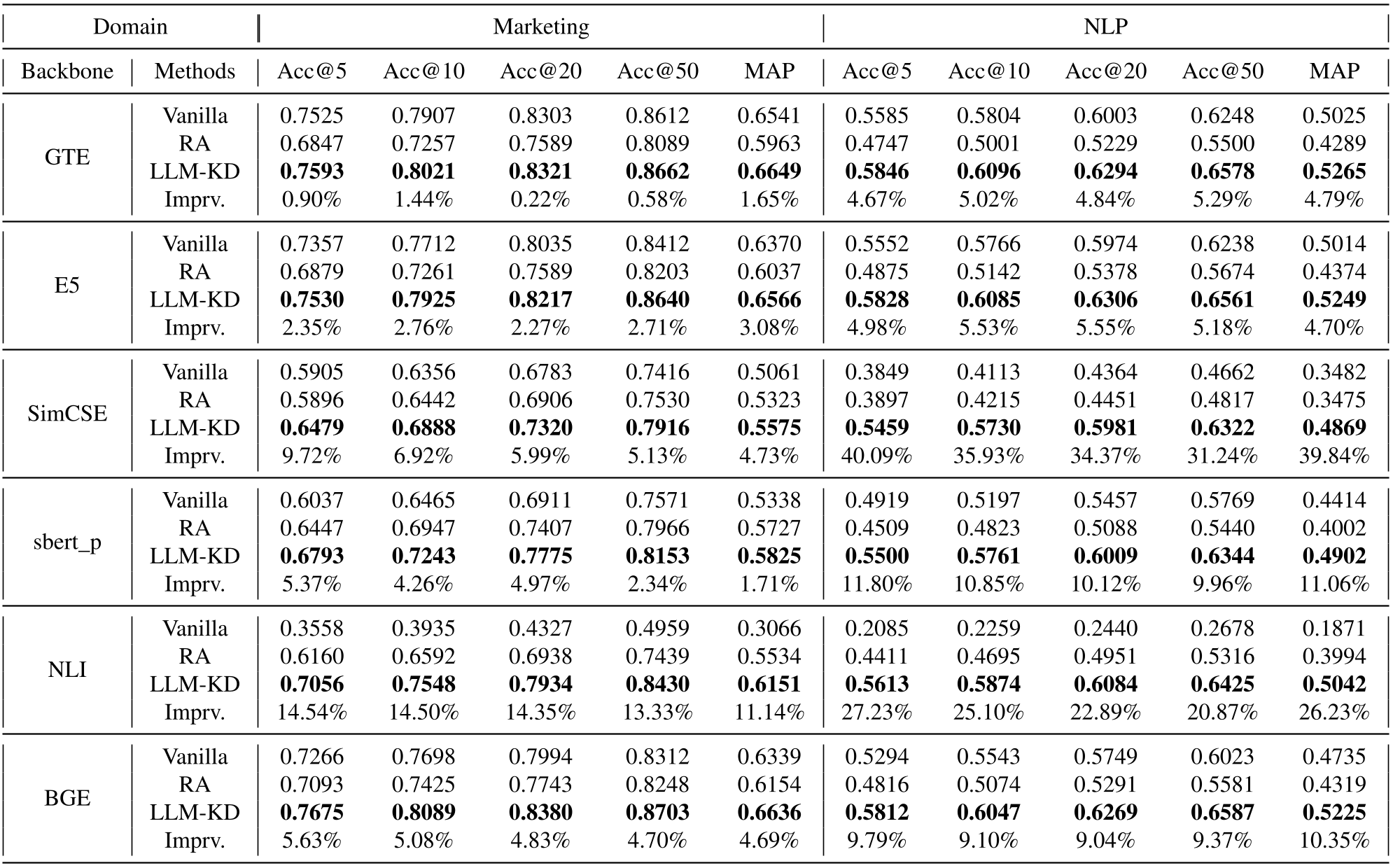
- Retrieval Prowess: The LLM-KD retriever improved MAP by 15.19% in the NLP domain. It was particularly effective at spotting "Incremental" ideas that usually fool standard search engines.
- Detection Accuracy: The full pipeline achieved a significant gain in F1-score and Accuracy, outperforming heuristic-based methods by over 24% in the Marketing domain.
Critical Insight & Future Outlook
The genius of this paper lies in its realization that novelty is a relational property, not an intrinsic one. You cannot judge if an idea is "new" by looking at the idea alone; you must look at its distance from the "closed set" of all previous ideas.
Limitations:
- Binary vs. Spectrum: Currently, it's a binary "Novel vs. Non-Novel" classifier, but science often operates in shades of gray.
- LLM Noise: The system relies on the LLM's initial "idea extraction" being accurate.
Conclusion: As AI begins to generate its own research hypotheses at scale, tools like this will be the "spam filters" of the academic world—ensuring that the scientific community focuses on truly disruptive breakthroughs rather than incremental noise.